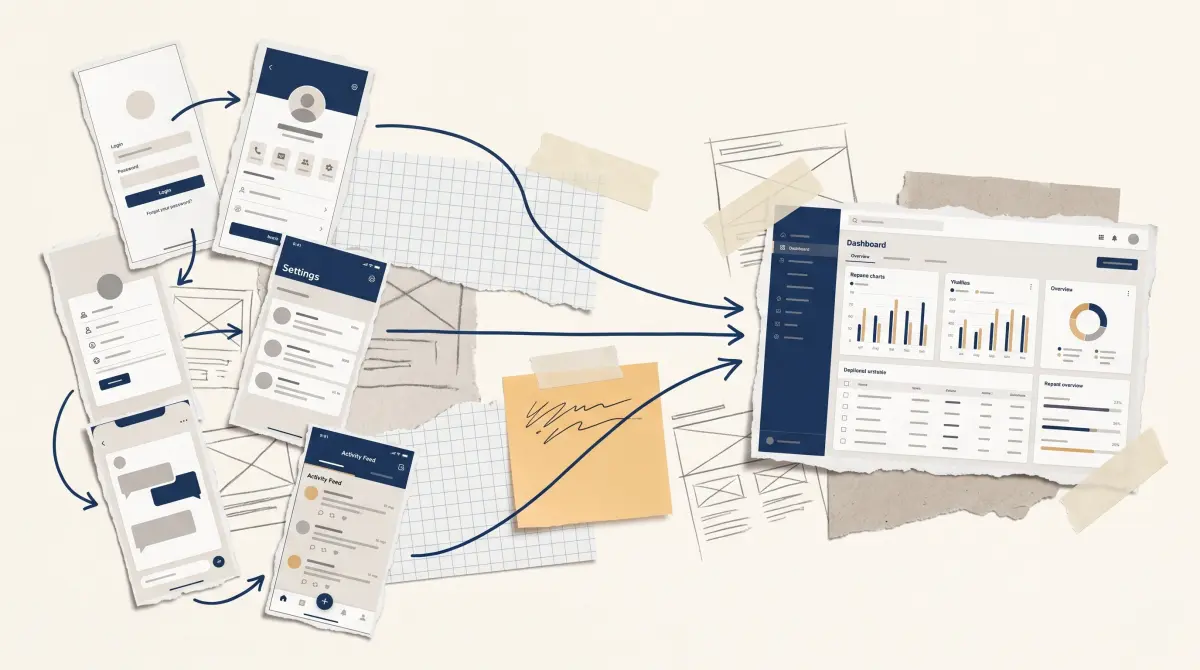
Custom software development is the process of designing, building, and deploying software applications tailored to a specific business's needs, rather than using generic off-the-shelf products. In Cape Town and across South Africa, custom software development is growing rapidly: the South African custom software market was valued at USD 1.14 billion in 2024 and is projected to reach USD 3.63 billion by 2030, growing at 21.1% annually, according to Grand View Research. The average company now uses over 100 SaaS applications, according to BetterCloud, and businesses are increasingly discovering that stitching together five or six SaaS subscriptions creates more problems than it solves.
This is the story of how we went from managing five separate marketing tools to building one unified platform that does everything better. It's not a theoretical piece about why custom software is great. It's a practical case study of what we built, why we built it, and what happened after we did.
The problem: five tools, zero integration
Before we built our own platform, our marketing workflow looked like this: we used one tool to manage Meta (Facebook and Instagram) advertising data, another for SEO auditing, a third for content creation, a fourth for research and person profiling, and a fifth for publishing content across channels. Each tool did its job reasonably well in isolation. Together, they were a nightmare.
The real cost wasn't just the subscriptions. It was the time lost switching between platforms, the data that didn't sync, the manual copy-pasting of insights from one tool to another, and the constant feeling that we were working around our tools instead of with them. We estimated that our team was spending 8-10 hours per week just on tool management: logging in, exporting data, reformatting it, and importing it somewhere else.
We're not alone. According to the Zylo 2025 SaaS Management Index, 52.7% of purchased SaaS licenses sit completely idle, and the average enterprise wastes $21 million annually on unused software. Meanwhile, MuleSoft's 2025 Connectivity Benchmark found that only 29% of enterprise applications are integrated, with 95% of IT leaders struggling to connect data across systems. The tool sprawl problem isn't unique to us. It's an industry-wide pattern.
What we replaced: the 5-tool stack
Here's a breakdown of the five separate tools we were using and what our custom platform replaced them with:
| Function | Before (Separate Tools) | After (Custom Platform) |
|---|---|---|
| Ad intelligence | Third-party Meta ad aggregator with limited export | Direct Meta API integration with real-time dashboards and custom KPIs |
| Person profiling | Manual research across LinkedIn, company sites, news | AI-powered profiling engine using Perplexity API for automated prospect research |
| Content creation | Separate writing tool with no brand context | Brand-aware content engine trained on company voice, with topic and keyword input |
| SEO auditing | Third-party SEO tool, separate login, manual report export | Built-in SEO audit module connected directly to content pipeline |
| Publishing | Manual copy-paste to CMS, social platforms, email | One-click auto-publish across all channels from a single dashboard |
How we built it
We didn't start with a grand vision for a "marketing platform." We started with the single biggest pain point: the Meta ad data was scattered and impossible to act on quickly. So we built a clean Meta API integration that pulled all ad performance data into one dashboard with the specific KPIs we actually cared about.
Once that was working, a natural question emerged: "What if we could see who these leads are before we call them?" That led to the person profiling module, which uses AI to automatically research prospects the moment they enter the pipeline. Instead of a sales rep spending 20 minutes Googling someone before a call, the system serves up a complete profile in seconds: company details, role, recent news, likely pain points, and suggested talking points.
The content and SEO modules followed the same organic pattern. Each one solved a specific problem we were actually experiencing, and each one connected to the modules that already existed. The result is a platform where data flows naturally from advertising intelligence to prospect profiling to content creation to SEO validation to multi-channel publishing. No exports. No copy-paste. No switching tabs.
The results
What changed after we consolidated
- 01 8-10 hours per week recovered from eliminating tool-switching, data exports, and manual cross-referencing.
- 02 5 subscriptions eliminated, replaced with a single self-hosted platform with no per-seat licensing.
- 03 Prospect research time cut from 20 minutes to under 30 seconds per lead with automated AI profiling.
- 04 Content-to-publish cycle reduced from days to hours with integrated creation, SEO check, and auto-publish.
- 05 Single source of truth for all marketing data instead of fragmented insights across five different dashboards.
Bonus build: the sales co-pilot
While building the marketing platform, we identified another problem that custom software could solve: sales call quality. Our sales team was good, but inconsistent. Some reps remembered every product detail; others stumbled when prospects asked technical questions. Training helped, but knowledge faded between sessions.
So we built a sales co-pilot: a real-time AI assistant that listens during sales calls and surfaces relevant information as the conversation unfolds. It works by building a self-learning knowledge base from every call transcript. The more calls it processes, the smarter it gets. When a prospect asks about a specific capability, the co-pilot instantly serves up the answer, relevant case studies, and suggested responses to the rep.
This isn't about replacing salespeople. It's about giving every rep access to the collective knowledge of the entire team, in real time, without them having to memorise a 200-page product manual.
Custom software vs off-the-shelf: when does it make sense?
Custom software isn't always the answer. If a well-built SaaS product solves your problem cleanly and completely, use it. Custom development makes sense when one or more of these conditions are true:
- You're using 3+ tools to do one job: If your workflow requires exporting data from Tool A, reformatting it, and importing it into Tool B, that's a sign the tools aren't serving you.
- Your SaaS costs are climbing with no ceiling: Many SaaS tools charge per seat, per contact, or per usage tier. As you grow, costs scale faster than value. Custom software has fixed hosting costs regardless of team size.
- You need your tools to think together: If the value is in the connection between data sources (e.g., ad performance informing content strategy informing sales conversations), no amount of Zapier integrations will match a purpose-built system.
- Off-the-shelf tools are 70% right: If you're constantly working around limitations, requesting features that never ship, or building spreadsheets to supplement what a tool should do, you've outgrown it.
- Data privacy matters: Custom, self-hosted software keeps your data on your infrastructure. No third-party access, no shared databases, no surprise privacy policy changes.
What custom software development looks like in practice
The phrase "custom software development" sounds intimidating. It conjures images of year-long projects, million-rand budgets, and teams of 20 developers. That's one way to do it. Here's how we do it at Digiholix in Cape Town:
- Identify the core workflow: We map out the specific process that's broken, inefficient, or too expensive. Not the whole business. One workflow.
- Build a working prototype in 2-4 weeks: Not a mockup. Not a wireframe. A functional prototype with real data that your team can actually test.
- Test with real users, real data: The prototype runs alongside your existing tools. Your team uses both and tells us what works and what doesn't.
- Iterate based on feedback: We refine, adjust, and improve based on how your team actually uses the software. Not on assumptions.
- Deploy and connect: Once the module works, we deploy it and connect it to your existing systems via APIs. Then we move to the next workflow.
This incremental approach means you see value within weeks, not months. And each module pays for itself before the next one starts.
The bigger picture for South African businesses
South Africa's tech industry is growing fast. Cape Town specifically has become a hub for software development, with a thriving startup ecosystem and a growing pool of engineering talent. But here's what I see most local businesses miss: you don't have to be a tech company to benefit from custom software.
If you're a retail business spending hours reconciling inventory across three systems, that's a custom software problem. If you're a professional services firm whose consultants waste half their day on admin instead of client work, that's a custom software problem. If you're a manufacturing company whose sales team can't access real-time production data, that's a custom software problem. The common thread isn't the industry. It's the gap between what your tools do and what your business actually needs.
Frequently asked questions
How much does custom software development cost in Cape Town?
A single-module build (one workflow or tool replacement) typically costs between R80,000 and R250,000 depending on complexity. A multi-module platform like the one described in this article develops over time, with each phase paid for independently. Compare this to the cumulative cost of multiple SaaS subscriptions that can easily exceed R15,000-R40,000 per month as your team grows.
How long does it take to build custom software?
A working prototype of a single module takes 2-4 weeks. A polished, production-ready module takes 4-8 weeks. Multi-module platforms are built incrementally over 3-6 months, with each module delivering value independently. This is significantly faster than traditional enterprise software projects because we build iteratively rather than trying to deliver everything at once.
What happens if we need changes after the software is built?
That's one of the core advantages of custom software: you own it, and it can be modified anytime. Unlike SaaS products where you submit feature requests and hope, custom software adapts to your business as it evolves. We offer ongoing support and development, or we can train your in-house team to manage and extend the platform.
Can custom software integrate with our existing tools?
Yes. Custom software is built to connect with your existing systems via APIs. It doesn't replace everything overnight. It sits alongside your current tools and gradually takes over specific functions as each module proves itself. Most modern SaaS platforms have APIs that allow custom software to read and write data seamlessly.
Is custom software only for large companies?
No. In fact, SMEs often benefit most because they can't afford the inefficiency of disconnected tools. A team of 10 people losing 8 hours per week to tool-switching is losing the equivalent of a full employee. Custom software built to solve that specific problem often costs less than a year of the SaaS subscriptions it replaces.
Paying for tools that don't talk to each other?
Book a free 30-minute audit and we'll map your current tool stack, identify where custom software would deliver the biggest ROI, and give you a straight answer on whether it makes sense for your business.
Book Your Free Audit