Data capture and admin
Enter it once. Everything updates.
Information entered once, validated on entry, and sent automatically to every system that needs it.
 See it in the case study
We find the manual steps costing your team hours every day, redesign them, and build systems that run them for you. Bespoke automation for businesses in Cape Town, across South Africa and internationally.
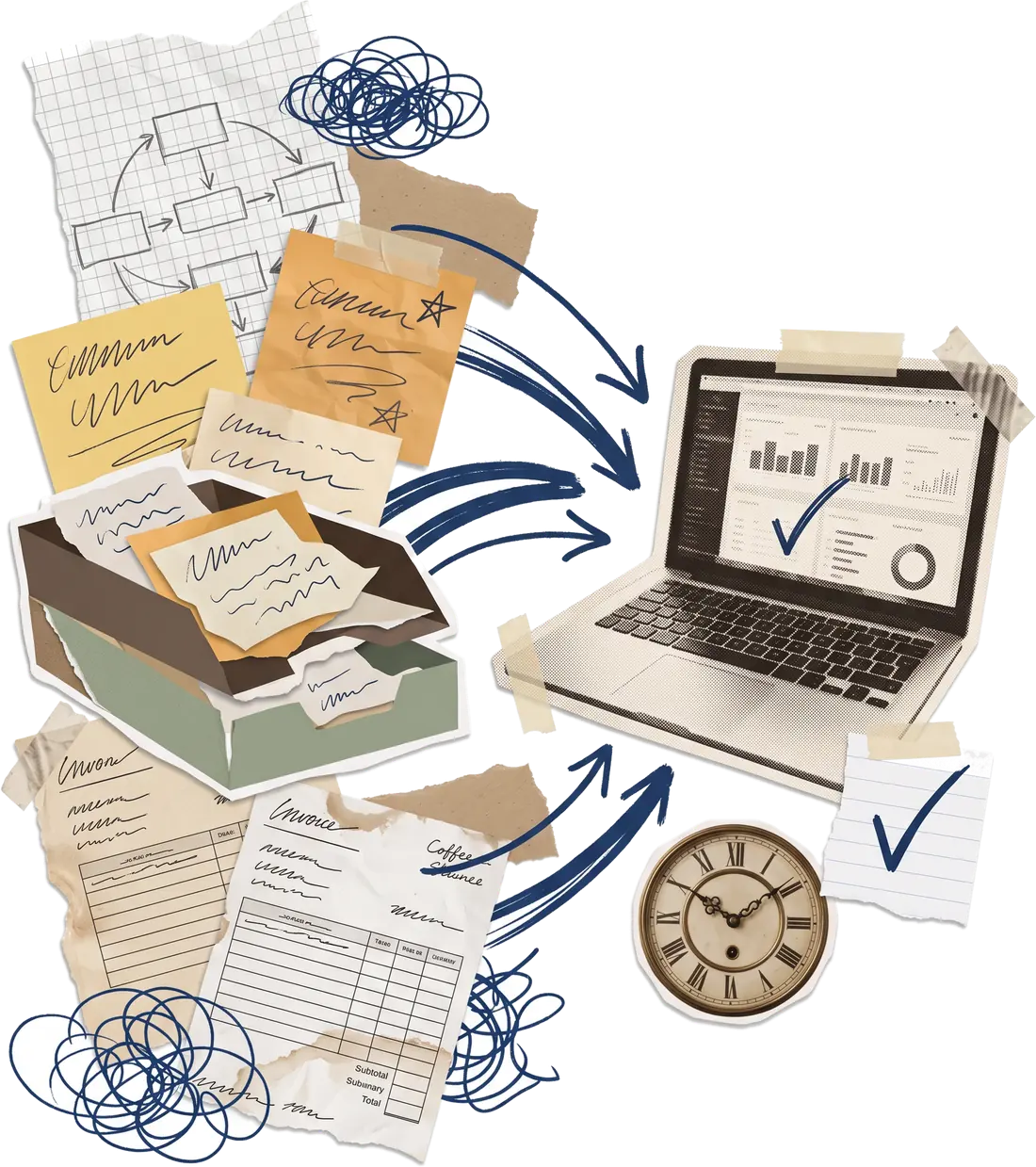
Results from one of our admin automation projects. See the case study
Business process automation is the use of software to run repeatable business tasks, such as data capture, approvals, invoicing and follow-ups, with little or no manual work.
Done properly, it doesn't just put the old steps on a screen. It questions which steps need to exist at all, removes the ones that don't, and automates the rest. That is where the real time and cost savings come from.
Tick what sounds familiar. We've filled in typical hours per week, so change them to match your business and watch the receipt add up.

TIME RECEIPT
Your week, in hours lost to manual work
That's about 14,4 full working weeks a year.
Find these hoursTypical figures. Change the hours to match your business.
The repeatable, rules-based work that eats your team's day, each one measured by what it gives back.
Data capture and admin
Information entered once, validated on entry, and sent automatically to every system that needs it.
See it in the case study
Quotes, invoices and payments
Quotes from templates, invoices on time, and reminders that send themselves.
Client onboarding and intake
Forms, documents, contracts and welcome steps run the moment a client signs.
Bookings and scheduling
Appointments booked, confirmed and reminded, with your calendar always current.
Reporting and dashboards
The figures you check every week, collected and presented for you.
Email and WhatsApp follow-ups
The right message at the right time, so leads and customers never go cold.
Case study · admin automation
4+ hours
of admin back, every day.
Project data used to move through ten manual steps: spreadsheets updated by hand, data copied between systems, approvals queued in inboxes. We redesigned it around three: capture, organise, distribute.
Read the full case studyA precise, four-step process. You get a clear quote before anything is built.
A 30-minute session to find the process costing you the most time, and what fixing it would take.
You get: the one process worth fixing first.
We map every step, remove the ones that shouldn't exist, and design the new flow. Then you get a fixed quote.
You get: a redesigned process and a fixed quote.
The new system runs alongside the old one until your team trusts it. No big-bang switchover.
You get: the new system live, with the old one as a safety net.
We measure hours saved and errors removed, train your team, and document everything.
You get: the numbers, the documentation and a trained team.
There's no default stack we push. We learn how work actually moves through your business, then choose the simplest reliable way to automate it, measured by the outcome it delivers. No plug-and-pray.
Built for Service firms Professional practices Trades Education Retail Cape Town, across South Africa and internationally
Anything else? Ask us in the free audit, or send us a message.
Start with work that is repetitive, rules-based and frequent, and that costs the most hours or causes the most errors. Data entry, approvals, invoicing and follow-ups are usually the quickest wins.
It depends on how many steps and systems are involved. After the free audit and process mapping, you get a clear, fixed quote before anything is built.
A single process can often be automated in a few weeks, including the period where old and new run side by side. Larger, multi-system projects are phased so you see results early.
It replaces repetitive steps, not people. In our admin automation case study, the team got more than four hours a day back for skilled work that a system can't do.
Often not. Most automation connects the tools you already pay for. Where there is a real gap, we build custom software around your process.
Yes. We're based in Durbanville, Cape Town, and work with businesses across South Africa and internationally.

Free automation audit
Book a free 30-minute automation audit. We'll show you which process to fix first, and what it would take.
Book your free auditYou'll leave with
What happens next